A foundation is not a place to shop for the lowest bid. A bad pour will cost you the house. We pour foundations the way engineers spec them — with the right rebar, the right mix, and the right cure time.
Types of foundations we pour
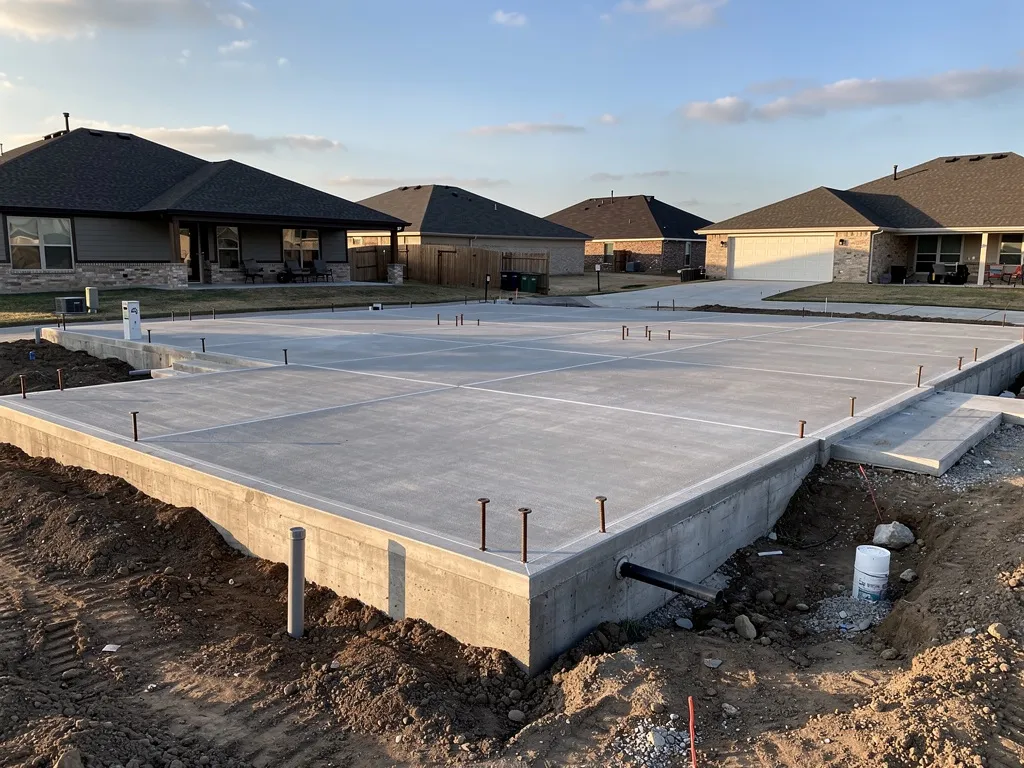
- Monolithic slab on grade — single pour, slab and footing in one, the most common for Lakeway-area homes on level lots
- Stem wall foundation — separate footings and stem walls, with the slab poured after the walls cure
- Pier and beam — for flood-prone areas near Lake Travis or sloped lots
- Pier and grade beam — engineered for hillside lots in West Lake Hills, Briarcliff, and parts of Hudson Bend
- Additions and outbuildings — garages, ADUs, shops, casitas
- Slab-only — for sheds, barns, and equipment pads (we also do driveways which use similar techniques)
How we engineer a foundation
Every foundation we pour is built to a stamped set of plans, either engineered by a local structural engineer or following the IRC for standard residential applications.
Soil evaluation. We start with a soil report or, for additions on known soil, we work from the original report if available. Expansive clay in this part of Texas requires specific detailing — moisture barriers, deeper turn-downs, or pier footings.
Forming and rebar. We form to plan, place rebar to spec (typically #4 bars on 16-inch centers for monolithic slabs), and chair all steel to maintain the proper cover. We use 3000 PSI minimum mix for foundations, stepping up to 3500 or 4000 for stem walls and grade beams.
Vapor barrier and insulation. A 10-mil vapor barrier goes under every slab we pour. For energy code compliance, we typically add 2 inches of rigid foam under the slab and around the perimeter.
Inspection and pour. We coordinate the city’s pre-pour inspection (typically the morning of the pour) and stay on-site for the entire pour. We use a concrete pump for most foundation pours to keep placement consistent.
Cure. We apply a curing compound and follow the engineer’s spec for cure time before framing. Most foundations need 7 days minimum before any load is applied.
Foundation pricing in the Lakeway area
A monolithic slab typically runs $8–$14 per square foot installed, depending on:
- Site prep (excavation, fill, compaction)
- Soil conditions (rock, expansive clay, or high water table)
- Slab thickness and reinforcement spec
- Engineering and inspection requirements
- Vapor barrier and insulation spec
A 2,000 sq ft home on a level lot with a standard monolithic slab typically lands between $16,000 and $28,000.
Stem wall foundations with crawl spaces run higher, typically $14–$22 per square foot, because of the additional forming, two pours, and the engineering involved.
Permit and engineering coordination
We work with several local structural engineers and can refer you to one if your project doesn’t have plans yet. For most residential additions and outbuildings in unincorporated Travis County, the engineering runs $1,800–$3,500 and the permit pulls in 2–4 weeks.
If you’re in the city limits of Lakeway, Bee Cave, or West Lake Hills, we coordinate the permit directly with the city and include the fees in our quote.
Foundations are too important to leave to chance. Get a free consultation and we will walk the site, review the plans, and give you a number you can build a budget around.