
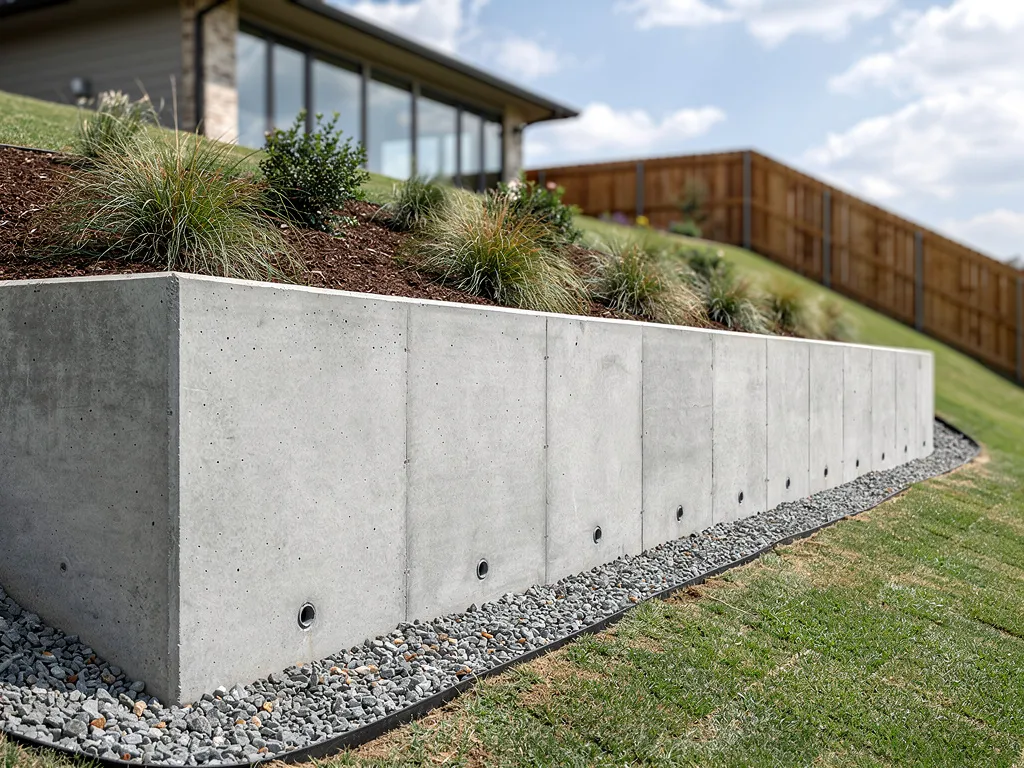
A retaining wall is structural, not decorative. Done wrong, it fails — bowing, cracking, or in the worst cases, collapsing onto whatever it was holding back. We build retaining walls to engineer specs, with the drainage and reinforcement that the Hill Country’s expansive clay demands.
Types of retaining walls we build
- Poured-in-place concrete — the strongest option, monolithic pour with vertical rebar and a proper footing
- CMU (concrete masonry unit) — concrete block walls, grouted solid with rebar, often used for taller walls
- Tiered walls — multiple shorter walls stepped back into the slope, easier to permit and visually softer
- Gravity walls — short walls (under 4 feet) that rely on their own weight, often with a battered face
- Counterfort or cantilevered — for taller engineered walls, with a footing stem and heel
Engineering and permits
Any retaining wall over 4 feet in height (measured from the bottom of the footing to the top of the wall) requires a structural engineer’s stamp and a permit in Travis County. Most cities in our service area require engineering for any wall that retains a surcharge — meaning anything that adds load above the wall, like a driveway or a structure.
We work with several local structural engineers and handle the entire process:
- Site evaluation and wall height confirmation
- Soil bearing capacity review
- Engineered wall design
- Permit pull with the city or county
- Inspection coordination
Drainage — the part most contractors skip
A retaining wall without proper drainage fails within 5–10 years. Water builds up behind the wall, saturates the soil, and pushes the wall outward through hydrostatic pressure. We install:
- 12-inch perforated drain pipe behind the wall, in a gravel envelope
- Gravel backfill minimum 12 inches behind the wall
- Mirafi geotextile fabric to keep fines from clogging the drain
- Weep holes every 8–10 feet at the base (for CMU walls)
- Daylighted drain outlet to daylight or a French drain
This costs a little more upfront but adds decades to the wall’s life.
Retaining wall pricing in the Lakeway area
Pricing is per square foot of wall face (height × length). The biggest variables are wall height, soil conditions, and access.
- Poured-in-place, under 4 ft: $45–$65 per sq ft
- Poured-in-place, 4–8 ft (engineered): $65–$95 per sq ft
- CMU, under 4 ft: $40–$60 per sq ft
- CMU, 4–8 ft (engineered, grouted): $55–$85 per sq ft
- Tiered walls: $50–$90 per sq ft, depending on the number of tiers
A typical 4-foot tall, 40-foot long poured wall in Lakeway runs $9,000 to $13,000 installed, including engineering, permits, drainage, and backfill.
Retaining wall finishes
- Smooth trowel — clean, modern, can be stained or painted
- Broom finish — slip-resistant, low-maintenance
- Stamped and colored — see our stamped concrete page
- Stone-veneer faced — natural limestone or cast stone adhered to the wall face
- CMU split-face — a textured block that looks like cut stone
What we won’t do
We will not build a wall over an unconfirmed utility, on a slope with active erosion we have not addressed, or without a proper footing depth (typically 24–30 inches below grade in our clay soils). We have seen too many failed walls in the Lake Travis watershed to take shortcuts here.
Send us a photo of the slope, the rough height and length, and what you need to hold back. We will let you know the same week whether a wall is the right solution.